Instagram has become much more than a platform for sharing photos and short videos. For businesses, it can work as a discovery channel, trust-building platform, customer service channel, and lead-generation tool – all at the same time.
But simply posting every day does not guarantee growth.
A business can publish attractive Reels, use popular hashtags, and still struggle to generate enquiries. The difference usually comes down to strategy: knowing what to publish, who you are trying to reach, what action you want people to take, and how you measure the result.
After working with digital marketing campaigns, one lesson becomes clear: Instagram marketing works better when content, audience, branding, and conversion are planned together.
In this article, we will discuss 15 proven Instagram marketing tips to grow your brand, covering audience research, profile optimisation, content strategy, Instagram SEO, Reels, Stories, engagement, lead generation, advertising and performance measurement. The goal is not simply to increase follower numbers, but to understand how Instagram can be used as a meaningful channel for brand awareness, customer engagement and business growth.
What Is Instagram Marketing?
Instagram marketing is the process of using Instagram to promote a brand, build relationships with potential customers, showcase products or services, generate leads, and drive business results.
It can include:
- Organic posts
- Instagram Reels
- Stories
- Carousels
- Instagram Live
- Influencer and creator collaborations
- Community engagement
- Instagram SEO
- Paid Instagram advertising
- Lead-generation campaigns
- Direct-message conversations
A strong Instagram strategy does not depend on one content format. It uses different formats for different stages of the customer journey.
Goal | Instagram Content to Consider |
Brand awareness | Reels, educational posts, creator content |
Engagement | Polls, questions, carousels, Stories |
Trust building | Testimonials, case studies, behind-the-scenes |
Lead generation | Lead ads, DM campaigns, offers |
Sales | Product demonstrations, testimonials, retargeting ads |
Customer retention | Stories, community content, exclusive updates |
1. Start With a Clear Instagram Marketing Objective
Before creating content, decide what Instagram is supposed to achieve for your business.
“Get more followers” is usually too broad.
Instead, define a measurable business objective such as:
- Generate 50 qualified enquiries per month
- Increase website traffic
- Build awareness in a particular city
- Increase product sales
- Get more consultation bookings
- Build a community around your brand
- Generate enquiries through Instagram DMs
For example, a digital marketing institute in Thane might use Instagram primarily to generate course enquiries. Its content should therefore educate potential students while gradually building enough trust for them to enquire.
Your content strategy becomes much easier when the business goal is clear.
2. Understand Your Target Audience
Understanding the target audience is one of the most important parts of Instagram marketing. A brand cannot create relevant communication without knowing who it is speaking to.
Businesses should understand the characteristics, interests, problems, expectations and purchasing behaviour of their potential customers. Location can also be important, particularly for businesses that provide services within a specific geographical area.
For example, a local restaurant in Mumbai may focus on people living or working nearby, while an online education company may target students across several cities. Their Instagram strategies should therefore be different.
Audience understanding also influences the language, visual style, content topics and offers used by the business. When content addresses an actual problem or interest of the target audience, it becomes more relevant and has a better chance of generating meaningful interaction.
3 Optimise the Instagram Business Profile
An Instagram profile should be treated as an important part of the customer’s first interaction with a brand. Someone may discover a business through a Reel or another person’s recommendation and then visit its profile to understand what the company offers.
The profile should therefore communicate the brand’s identity and purpose clearly.
A strong Instagram profile generally includes a recognisable profile image, an understandable username, a useful bio, relevant keywords, location information where applicable and a clear call to action. Businesses should also make appropriate use of the website link and Story Highlights.
For example, a digital marketing institute serving students in Thane could mention digital marketing training, practical learning, relevant course areas and its location within the profile. This immediately gives visitors useful context.
A well-optimised profile can make the difference between someone simply viewing an account and someone deciding to contact the business.
4. Create Content That Solves Real Problems
One of the strongest principles of Instagram marketing is that content should provide value to the intended audience. Businesses often make the mistake of creating posts primarily around their own products and services.
Customers, however, are usually more interested in their own problems.
A skincare company can educate its audience about common skincare mistakes. A financial consultant can explain basic investment concepts. A real estate company can discuss factors buyers should consider before purchasing a property. A digital marketing institute can explain how SEO, social media marketing and paid advertising work.
This type of content establishes relevance before the business asks the audience to purchase something.
Over time, consistently useful content can also contribute to brand credibility because people begin associating the business with useful information rather than advertisements alone.
5. Use Instagram Reels as Part of a Wider Content Strategy
Short-form video has become an important component of social media marketing. Instagram Reels can help businesses present information in an easy-to-consume format and reach audiences who may not already follow the account.
However, Reels should not become the entire Instagram strategy.
Different content formats perform different communication functions. Reels can introduce ideas and attract attention, while carousels can explain topics in greater detail. Stories can encourage interaction, and testimonials can provide social proof.
For example, a digital marketing institute might publish a Reel explaining three common SEO mistakes. A carousel could then explain how to correct those mistakes, while Stories could answer questions from viewers.
The strength comes from connecting these formats rather than treating every post as an independent piece of content.
6. Pay Attention to the Opening of Your Content
The first few seconds of a short video can influence whether someone continues watching. This is why the opening message or visual needs to immediately establish relevance.
Instead of beginning with a generic introduction, businesses can start by presenting a problem, question, surprising observation or useful promise.
For example, a digital marketing video could begin with:
“Posting on Instagram every day but still getting no enquiries?”
This immediately identifies a common problem for businesses.
Similarly, a fitness brand might begin with:
“You don’t need two hours in the gym to start getting fit.”
The purpose of the opening is not to use exaggerated clickbait but to quickly communicate why the content may be useful to the viewer.
7. Develop Consistent Content Pillars
A successful Instagram account usually has some level of content structure. Content pillars are the main subjects around which a brand regularly creates content.
For a digital marketing institute, these pillars could include digital marketing education, career guidance, student experiences, industry updates and course-related information.
For a jewellery brand, the pillars could include product education, styling ideas, customer experiences, new collections and behind-the-scenes content.
Content pillars help maintain consistency while preventing the account from becoming repetitive. They also make planning easier because the business does not have to create every post from scratch without direction.
More importantly, content pillars help communicate what the brand is known for.
8. Incorporate Instagram SEO Into Your Content
Instagram is not only a social networking platform; it can also function as a discovery platform. Users search for topics, businesses, products, services and information directly within social platforms.
For this reason, businesses should use relevant language throughout their Instagram presence.
Keywords can naturally appear in the profile name, bio, captions, on-screen content and other relevant areas. A business serving a particular city can also mention the location where appropriate.
For example, a company offering digital marketing training could naturally use phrases such as “digital marketing course in Thane” or “digital marketing training” when they accurately describe its services.
The objective should not be keyword stuffing. The content should remain natural and useful while providing clear context about the subject and business.
9. Use Hashtags Strategically
Hashtags can provide additional context about the subject of a post and help categorise content. However, hashtags should not be treated as the main solution for Instagram growth.
A strong Instagram post should already have relevant content, a clear topic and an appropriate audience. Hashtags can support that strategy rather than replace it.
Businesses can use hashtags related to their industry, topic, location or specific niche.
For example, a local education business might combine industry-related and location-related terms when they are genuinely relevant.
Using unrelated popular hashtags simply because they have a large number of posts may not attract the right audience.
The focus should remain on relevance rather than quantity.
10. Use Customer Questions as Content Ideas
Businesses receive valuable content ideas every day through customer conversations. Questions asked through Instagram messages, WhatsApp, emails, sales calls and comments can reveal exactly what potential customers want to know.
For example, if a digital marketing institute frequently receives the question, “Can beginners learn digital marketing without a technical background?”, that question can become an educational Instagram post.
Similarly, if a real estate company regularly receives questions about home-loan eligibility, it can create a detailed educational post addressing that topic.
This approach makes content more customer-focused because it is based on actual conversations rather than assumptions.
It can also reduce the pressure of constantly trying to invent new content ideas.
11. Build Trust Through Proof and Experience
People are more likely to trust businesses that can demonstrate their expertise and previous work. This is particularly important for service businesses where customers cannot physically evaluate the service before making a decision.
Instagram provides several ways to demonstrate credibility.
Businesses can share testimonials, case studies, project examples, customer experiences, behind-the-scenes content and educational insights. A trainer can demonstrate how they teach. A marketing agency can explain how it approaches campaigns. A designer can show the process behind a project.
Instead of repeatedly telling the audience that the business is “the best,” demonstrating actual experience can create stronger credibility.
This is also closely connected with the principles of experience, expertise and trust that are important in modern content marketing.
12. Use Instagram Stories for Regular Communication
Instagram Stories provide a more informal way for businesses to communicate with their audience. Unlike highly planned feed content, Stories can be used for frequent updates, conversations and behind-the-scenes communication.
Businesses can use Stories to conduct polls, ask questions, share quick tips, introduce team members, announce events, display customer feedback and answer frequently asked questions.
For example, a training institute could ask its audience which digital marketing skill they find most difficult. The responses can then become the basis for future educational content.
Stories can therefore work as both a communication channel and a source of audience research.
13. Create a Clear Path From Content to Conversion
Instagram marketing should not stop when someone likes or watches a post. For businesses that want enquiries or sales, there should be a clear path between content consumption and conversion.
A simple customer journey might begin with a Reel that attracts attention. The user then visits the profile, reads additional content, views testimonials, clicks the website link or sends a direct message and eventually becomes a lead.
For example, a digital marketing institute could publish an educational Reel about career opportunities in digital marketing and invite interested viewers to send a specific keyword through DM for course information.
A service company could use a consultation offer, while an e-commerce business could direct users towards a product page.
The appropriate call to action depends on the business model and the stage of the customer’s decision-making process.
14. Use Instagram Advertising With a Clear Objective
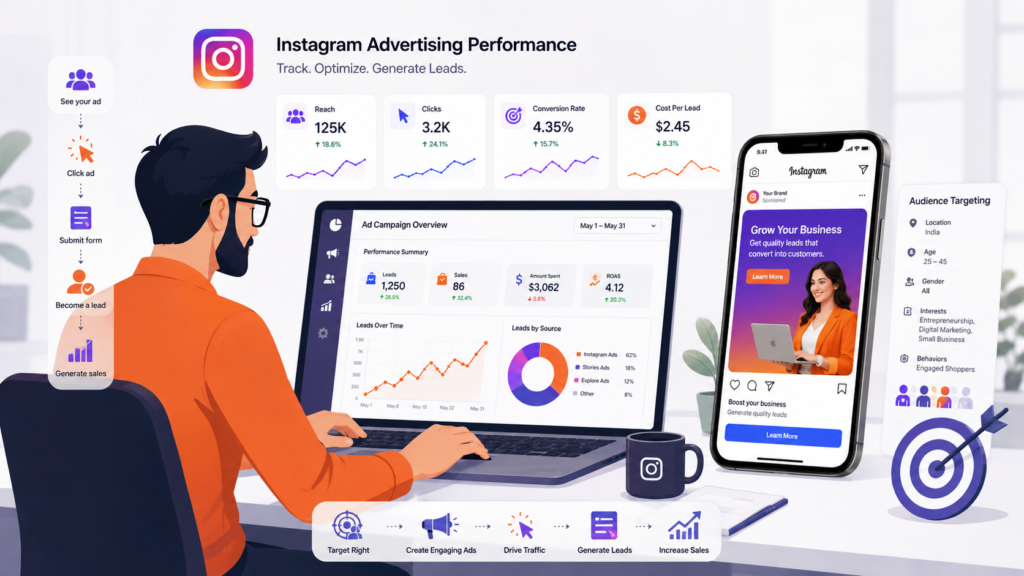
Organic Instagram marketing can build visibility and relationships, while paid advertising can help businesses reach selected audiences at scale.
Instagram advertising can be used for objectives such as awareness, traffic, leads, conversations and sales. Meta also provides advertising options designed to help businesses collect leads through forms and messaging.
However, effective advertising begins before the campaign is launched. The business should understand its audience, offer, creative message, landing page or conversation process and follow-up system.
For example, a digital marketing institute may run an advertisement promoting a new batch. A user sees the advertisement, submits an enquiry form, receives a call from the counsellor and eventually joins the course.
The advertisement is only one part of the process. The quality of the offer and the follow-up experience also influence the final result.
Businesses should therefore measure outcomes such as leads, qualified leads, cost per lead, sales and return on advertising investment rather than judging an advertisement only by likes or impressions.
15. Measure Results and Improve the Strategy
Instagram marketing becomes more effective when businesses regularly review performance and make decisions based on data.
Follower growth can indicate whether the account is attracting new people, while reach can show how widely content is being distributed. Saves and shares can provide useful signals about content value. Profile visits, website clicks, direct messages and enquiries are more closely connected to business outcomes.
For a lead-generation business, the most important question may not be how many people liked a post but how many qualified enquiries it produced.
For example, an account with 5,000 followers that consistently generates relevant enquiries may be more valuable to a service business than an account with 20,000 followers but little commercial activity.
Businesses should therefore review which topics, formats and messages contribute to their objectives and gradually invest more effort in those areas.
How Instagram Marketing Supports the Customer Journey
Instagram can influence several stages of the customer journey.
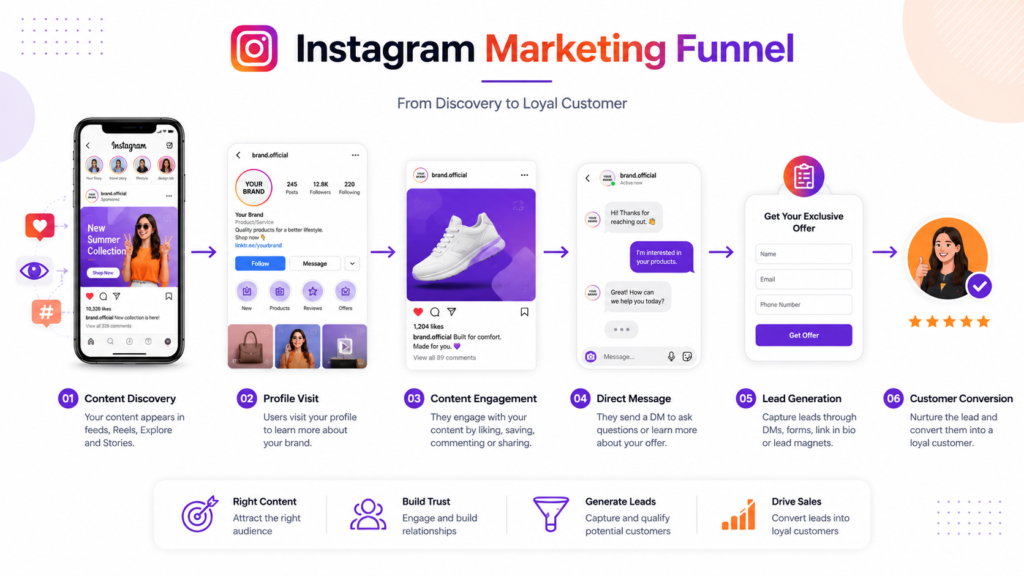
At the awareness stage, Reels and educational content can introduce the brand to new audiences. During the consideration stage, detailed posts, testimonials and case studies can help people understand the value of the product or service.
At the decision stage, clear offers, demonstrations, FAQs and direct communication can help remove uncertainty.
After purchase, Stories, community content and customer communication can help maintain the relationship.
This means Instagram should not be viewed only as a platform for gaining followers. It can participate in multiple stages of the marketing process.
Conclusion
Instagram marketing is no longer simply about maintaining a social media profile and publishing attractive images. For businesses, it can become an important part of the broader digital marketing process when content, audience research, branding, communication and conversion are connected.
The most important lesson is that Instagram growth should not be treated as a race for followers. A smaller but relevant audience can be more valuable than a large audience that has no interest in the business.
Businesses should focus on understanding their customers, answering their questions, creating useful content, demonstrating real expertise and giving interested people a clear next step.
Reels can attract attention. Educational posts can build authority. Stories can create conversations. Testimonials can establish trust. Paid advertising can expand reach. A strong conversion process can turn that attention into enquiries and customers.
When these elements work together, Instagram becomes a genuine marketing channel rather than simply another place to publish content.