Introduction: Meta Ads Are Becoming More Automated
Running Meta Ads used to involve a lot of manual decisions.
Advertisers would create multiple ad sets, define detailed interests, choose placements, divide budgets, test audiences and manually review performance. That approach still has a place, but Meta’s advertising system is moving in a different direction.
In 2026, AI is becoming a much bigger part of how Meta campaigns are created, delivered and optimised.
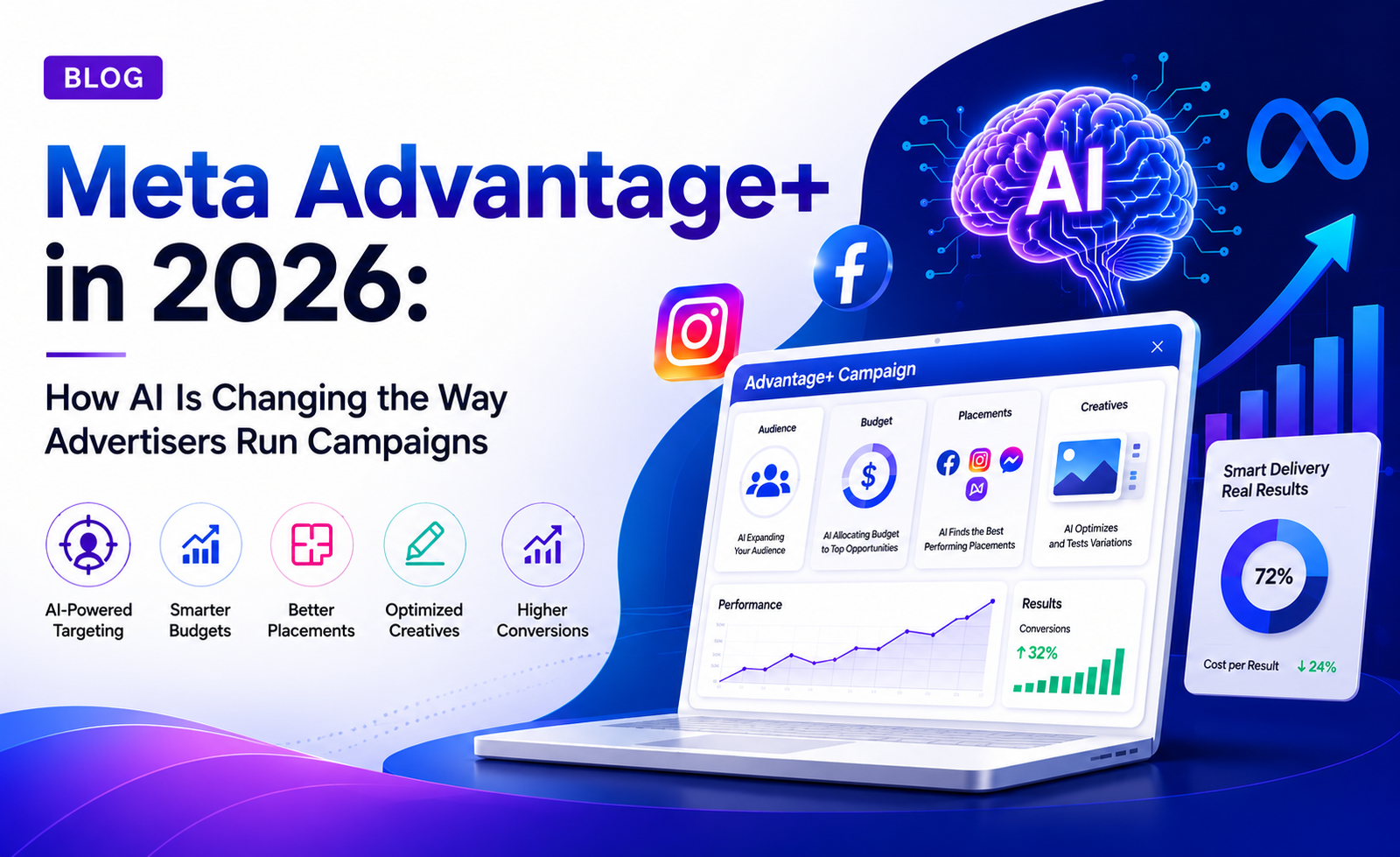
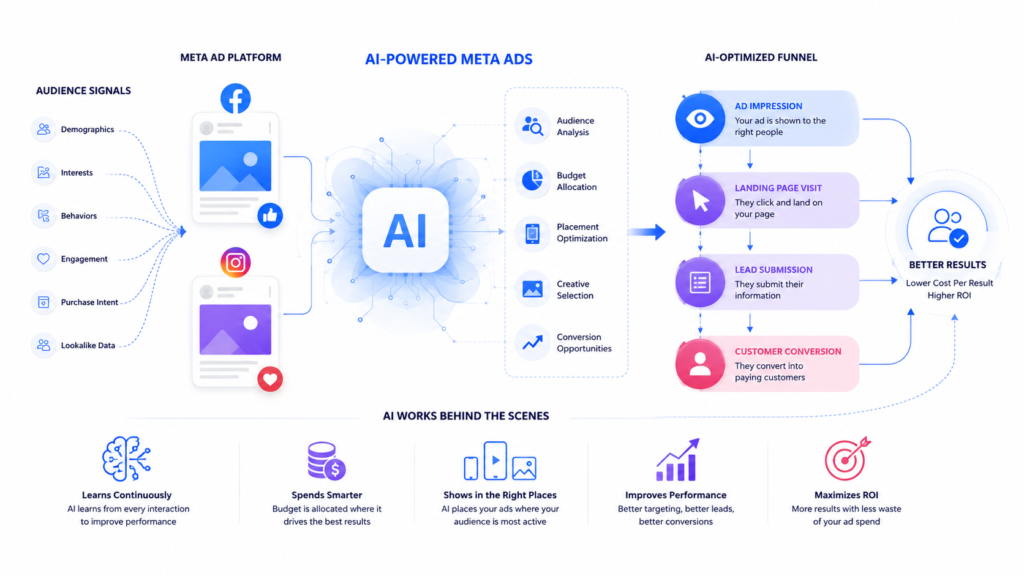
Meta Advantage+ is at the centre of that change. Instead of asking advertisers to control every campaign setting, Meta increasingly allows its AI systems to make decisions about audiences, placements, budgets and creative variations based on the likelihood of achieving the selected campaign goal.
The role is shifting from manually controlling every setting to providing better inputs, stronger creative, accurate conversion data and clear business goals.
For businesses spending money on Facebook and Instagram advertising, understanding this shift is becoming essential.
What Is Meta Advantage+?
Meta Advantage+ is Meta’s collection of AI-powered advertising solutions designed to automate and optimise different parts of a campaign.
Depending on the campaign type, Meta can use AI across:
- Audience targeting
- Budget allocation
- Ad placements
- Creative variations
- Delivery optimisation
- Conversion-focused campaign decisions
- Lead generation
- Sales campaigns
- App promotion
Meta describes Advantage+ as having both end-to-end campaign solutions and single-step solutions. End-to-end solutions can apply AI across multiple campaign components, while single-step tools automate specific parts of advertising.
For example, Advantage+ Sales Campaigns can automatically optimise creative, targeting, placements and budget for online sales. Advantage+ Leads Campaigns apply automation to lead-generation campaigns, while Advantage+ App Campaigns focus on app installs and post-install actions.
The important change is this:
Advertisers are increasingly telling Meta what outcome they want, while Meta’s AI decides how to find opportunities to achieve it.
How Meta Advantage+ Is Changing Campaign Management
The biggest change is not simply that Meta has added more AI features.
The bigger change is where campaign decisions are being made.
Previously, advertisers often decided:
“Who should see my ads?”
With Advantage+, the thinking becomes:
“Here is the type of customer and business outcome I want. Can Meta’s system find more people likely to take that action?”
Traditional Campaign Management vs Advantage+
| Area | Traditional Campaign Management | Advantage+ Approach |
|---|---|---|
| Audience | Detailed manual targeting based on interests, demographics and audience segments | AI-assisted audience expansion based on signals and predicted outcomes |
| Placements | Advertiser manually selects specific placements | AI automatically identifies and selects placement opportunities |
| Budget | Advertiser manually distributes budget across ad sets | AI reallocates budget toward opportunities with stronger potential |
| Creative | Advertiser manually creates and tests variations | AI can generate, adapt and optimise creative variations |
| Optimisation | Frequent manual campaign adjustments | Continuous AI-driven optimisation based on campaign performance |
| Testing | Multiple audience and ad-set combinations | Greater focus on creative concepts, offers and business inputs |
| Role of Advertiser | Campaign controller managing individual settings | Strategist providing the right data, creative, offer and business objectives |
This does not mean manual campaigns have disappeared.
Meta still provides manual controls in Ads Manager, but the platform increasingly encourages advertisers to use automation where it can improve delivery.
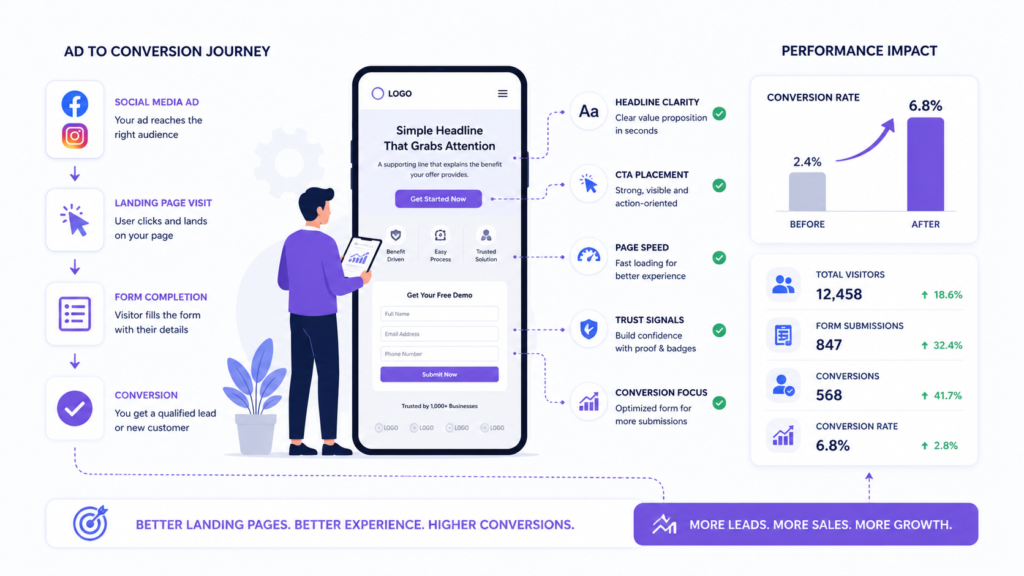
6. Landing Pages Still Matter
There is a common mistake in AI-driven advertising:
Advertisers focus heavily on campaign optimisation but ignore what happens after the click.
Meta can find a person likely to click or convert, but the landing page still needs to persuade that visitor.
A high-performing Meta campaign can lose money because of:
- Slow page loading
- Confusing messaging
- Weak headline
- Poor mobile design
- Long forms
- Missing trust signals
- Unclear pricing
- Weak CTA
- Poor offer-to-ad match
Example
If the ad says:
“Join a 4-Month Practical Digital Marketing Course”
the landing page should immediately reinforce that promise.
The visitor should not have to search through several sections to understand:
- What the course includes
- Who it is for
- Duration
- Practical training
- Location
- Fees
- Trainer experience
- Certification
- How to enquire
AI can improve ad delivery, but conversion rate optimisation still requires human judgement.
7. Measurement Is Becoming More Important Than Manual Tweaking
When campaigns become more automated, some advertisers make a mistake: they stop analysing performance.
Automation does not remove the need for measurement.
It makes good measurement more important.
Advertisers should monitor the complete customer journey.
For Lead Generation
Track:
Impression → Click → Landing Page View → Lead → Qualified Lead → Sales Conversation → Customer
For Ecommerce
Track:
Impression → Product View → Add to Cart → Checkout → Purchase → Revenue
Looking only at CTR or CPC can create misleading conclusions.
A creative with an excellent click-through rate may generate poor-quality traffic.
A campaign with a higher CPC may generate customers with much higher lifetime value.
The objective should therefore be to connect advertising data with actual business outcomes.
Landing Page Optimisation
8. What Advertisers Should Do Differently in 2026
The shift towards AI changes the advertiser’s job.
Instead of spending most of the time changing small targeting settings, marketers should focus on the inputs that influence the system.
1. Improve Your Conversion Tracking: Make sure Meta receives accurate conversion signals.
Check your Pixel, Events Manager, Conversions API and CRM integration where applicable.
2. Build More Creative Concepts: Do not rely on one image and one headline.
Create different creative angles around the same offer.
3. Give AI Better Data: Your customer lists, website activity and qualified conversion data can become useful signals for optimisation.
4. Stop Over-Segmenting Without a Reason: Creating dozens of tiny audiences can make campaign management unnecessarily complicated.
Test broader approaches where appropriate and allow the system enough room to find opportunities.
5. Optimise for Business Outcomes: Do not judge campaigns only by:
- CPM
- CTR
- CPC
- CPL
Also look at:
- Qualified leads
- Sales
- Revenue
- Customer acquisition cost
- Return on ad spend
6. Keep Human Strategy in Control: AI can process large amounts of information quickly. It does not understand your business exactly as your marketing team does.
Human judgement is still needed for:
- Positioning
- Offers
- Messaging
- Brand voice
- Customer psychology
- Creative concepts
- Business priorities
AI Ad Performance Improvement
1. AI Is Changing Audience Targeting
Audience targeting is one of the clearest examples of this shift.
With Advantage+ Audience, advertisers can provide audience suggestions such as customer information, interests or other signals. Meta’s system can then search beyond those suggestions when it believes additional people may be likely to respond.
This changes the way advertisers should think about targeting.
Instead of creating ten narrowly defined audiences, a better approach can be to provide Meta with:
- Strong first-party customer data
- Relevant audience suggestions
- Accurate conversion events
- Clear geographic restrictions
- Appropriate age or eligibility requirements
- A strong campaign objective
Meta can then use its models to identify patterns among people who are more likely to complete the desired action.
Example: Digital Marketing Institute
Imagine a digital marketing institute in Thane wants student enquiries.
A traditional approach might create separate audiences for:
- Digital marketing interests
- College students
- Job seekers
- Entrepreneurship
- Social media marketing
With an Advantage+ approach, the advertiser can provide useful audience signals and allow Meta’s system to search more broadly for people likely to submit an enquiry.
The important question becomes less about finding the “perfect interest” and more about giving Meta good signals and enough conversion data.
2. Budget Optimisation Is Becoming AI-Driven
Another major change is how campaign budgets are distributed.
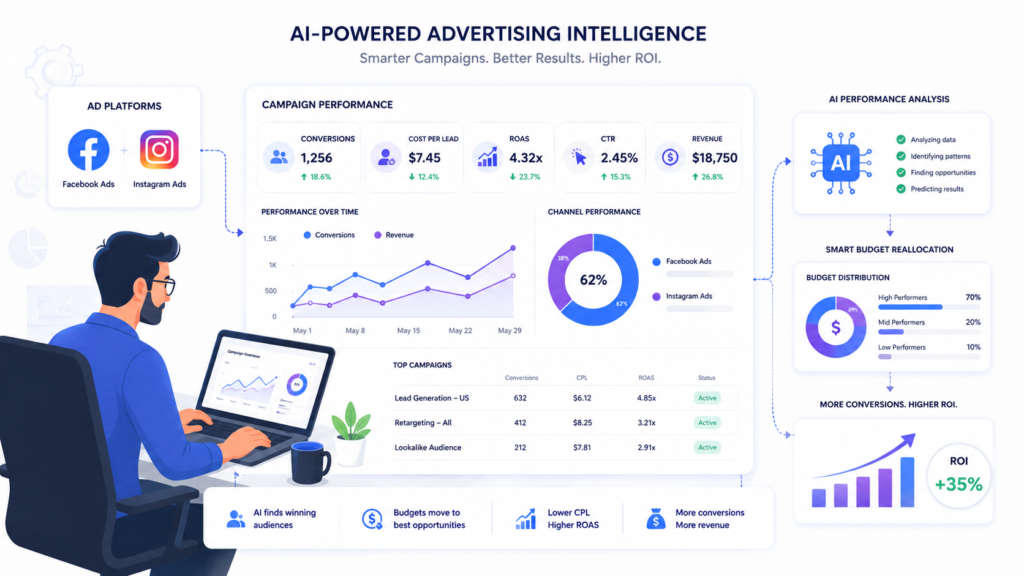
With Advantage+ Campaign Budget, advertisers can set a campaign-level budget rather than manually deciding how much every ad set should spend.
Meta’s system can then distribute the available budget across ad sets based on opportunities it identifies in real time.
For example, suppose a campaign has three audience groups:
Audience | Initial Budget | AI Opportunity |
Cold prospects | ₹1,000 | Medium |
Website visitors | ₹1,000 | High |
Existing leads | ₹1,000 | Low |
Instead of keeping the ₹1,000 allocation fixed, automated budget optimisation can move spending towards opportunities that appear more likely to produce results.
This is particularly useful when performance changes throughout the day.
However, advertisers should still monitor:
- Cost per lead
- Cost per qualified lead
- Conversion rate
- Revenue
- Return on ad spend
- Lead quality
Lower CPA does not automatically mean better business performance.
3. Placements Are No Longer Just a Manual Selection
Meta advertising now operates across a large ecosystem of placements.
Depending on eligibility and campaign setup, ads can appear across Facebook, Instagram, Messenger and Audience Network, including feeds, Stories and Reels. Advantage+ Placements allows Meta to automatically select placements where it sees opportunities for results.
This creates a practical challenge for advertisers:
Your creativity needs to work in more than one environment.
A design that looks good in a Facebook Feed may not work equally well in a vertical Story or Reel.
That means marketers need to think about:
- 9:16 video
- 4:5 feed creatives
- Short-form video
- Clear text hierarchy
- Strong opening frames
- Mobile readability
- Multiple creative concepts
AI may decide where an ad appears, but advertisers still need to create assets that are suitable for those environments.
4. Creative Testing Is Becoming More Important
One of the most important lessons from Meta’s AI-driven advertising model is that creative quality matters more than ever.
Advantage+ Creative can automatically make or adapt creative variations. Meta currently offers AI-powered features such as image expansion, background generation, text generation, image animation and music generation.
Meta also says its AI creative tools are being used by more than 4 million advertisers.
This creates an interesting situation.
AI can help produce more variations, but producing more ads does not automatically produce better ads.
Advertisers still need to test different:
- Hooks
- Offers
- Headlines
- Visual concepts
- Product benefits
- Testimonials
- Calls to action
- Video openings
For example, an online course could test:
Creative A: “Learn Digital Marketing in 4 Months”
Creative B: “Want a Career in Digital Marketing?”
Creative C: “Run Real Meta Ads While You Learn”
The AI system can help determine which variations are more likely to produce results, but the marketing team still needs to develop the ideas.
5. AI Is Changing Lead Generation Campaigns
Lead generation is another area where Meta is pushing automation heavily.
Advantage+ Leads Campaigns are designed to use Meta AI to find opportunities for generating leads. Meta states that Advantage+ leads campaigns delivered, on average, a 14% lower cost per lead and 10% lower cost per qualified lead in its reported results.
But there is an important distinction:
A cheap lead is not necessarily a valuable lead.
Suppose Campaign A generates:
- 100 leads
- ₹150 cost per lead
- 5 sales
Campaign B generates:
- 60 leads
- ₹250 cost per lead
- 15 sales
Campaign B has a higher CPL but may be significantly better for the business.
This is why advertisers should move beyond basic lead volume and feed stronger conversion information back into the advertising system.
Better Lead Generation Inputs
A strong setup can include:
- CRM integration
- First-party customer data
- Meta Pixel
- Conversions API
- Qualified-lead events
- Sales data
- Accurate conversion tracking
Meta specifically recommends connecting CRM data with Conversions API and optimising toward conversion leads when the goal is to identify higher-quality prospects.
Funnel Optimisation
Is Meta Advantage+ Better Than Manual Campaigns?
There is no universal answer.
It depends on the business, campaign objective, amount of conversion data, creative quality and account history.
Advantage+ can be particularly useful when:
- You have a clear conversion goal.
- Your tracking is reliable.
- You have sufficient conversion data.
- You have several creative variations.
- You want to scale campaigns.
- You are comfortable allowing Meta to automate parts of delivery.
Manual control may still be useful when:
- You have strict targeting requirements.
- You need specific exclusions.
- You are testing a highly controlled experiment.
- Your campaign has unusual business restrictions.
- You need to isolate specific variables.
The best strategy in 2026 is not necessarily AI versus manual advertising.
It is about knowing which decisions should be automated and which decisions should remain strategic.
The Future of Meta Advertising Is About Better Inputs
Meta Advantage+ is changing the skill set required from advertisers.
Campaign managers once spent significant time deciding exactly which audience should receive which ad and how much money each segment should receive.
AI can increasingly handle parts of that work.
The competitive advantage is moving towards:
Better creative + better data + better offers + better measurement.
Meta’s recent AI direction also suggests that creative automation will continue expanding. In July 2026, Meta announced that its Muse Image model would eventually power creative experiences for advertisers through Advantage+ Creative.
That means advertisers should prepare for a future where producing and testing creative variations becomes faster, while strategic thinking becomes more important.
The marketers who benefit most will not necessarily be the ones who automate everything.
They will be the ones who understand what to give the AI, what to measure, and when human judgement should override automation.
Conclusion
Meta Advantage+ is changing the way advertisers approach Facebook and Instagram campaigns.
The old model was heavily focused on manual targeting, placement selection, budget distribution and repetitive campaign adjustments.
The 2026 model is increasingly different.
Advertisers provide the objective, creative assets, business information and conversion signals. Meta’s AI then uses those inputs to make many delivery decisions in real time.
That does not make advertising easier in every sense.
It makes strategic thinking more important.
If you are running Meta Ads today, spend less time asking, “Which tiny targeting setting should I change?” and more time asking:
“Have I given Meta the right objective, the right data, the right creative and the right offer?”
That is increasingly where campaign performance is being won.